What Percentage of Your Income Should Be Left After Expenses?
How much of your income should remain after monthly expenses? Learn how to calculate your leftover income percentage, what different ranges can indicate, and why your savings rate, housing costs and essential spending matter.
You get paid. Your rent or mortgage comes out. Then utilities, groceries, transport, subscriptions, insurance, debt payments and everything else.
At the end of the month, something is left.
But what percentage of your income should actually be left after expenses?
Around 20% is commonly used as a useful reference point, but there is no percentage that works for everyone. Your income, housing costs, household size, debt, cost of living and financial goals all affect what is realistic.
Instead of treating one percentage as a rule, it is more useful to understand what your leftover percentage tells you about your overall financial flexibility.
How to calculate the percentage of income you have left
Start with your net income. This is the money you actually receive after taxes and mandatory deductions.
Then subtract all of your monthly expenses.
The amount remaining is your leftover income. To compare it properly with your earnings, convert it into a percentage.
Calculate your leftover income percentage
Leftover Income % = (Net Income − Monthly Expenses) ÷ Net Income × 100 For example, if your expenses consume 80% of your take-home income, your leftover income rate is 20%.
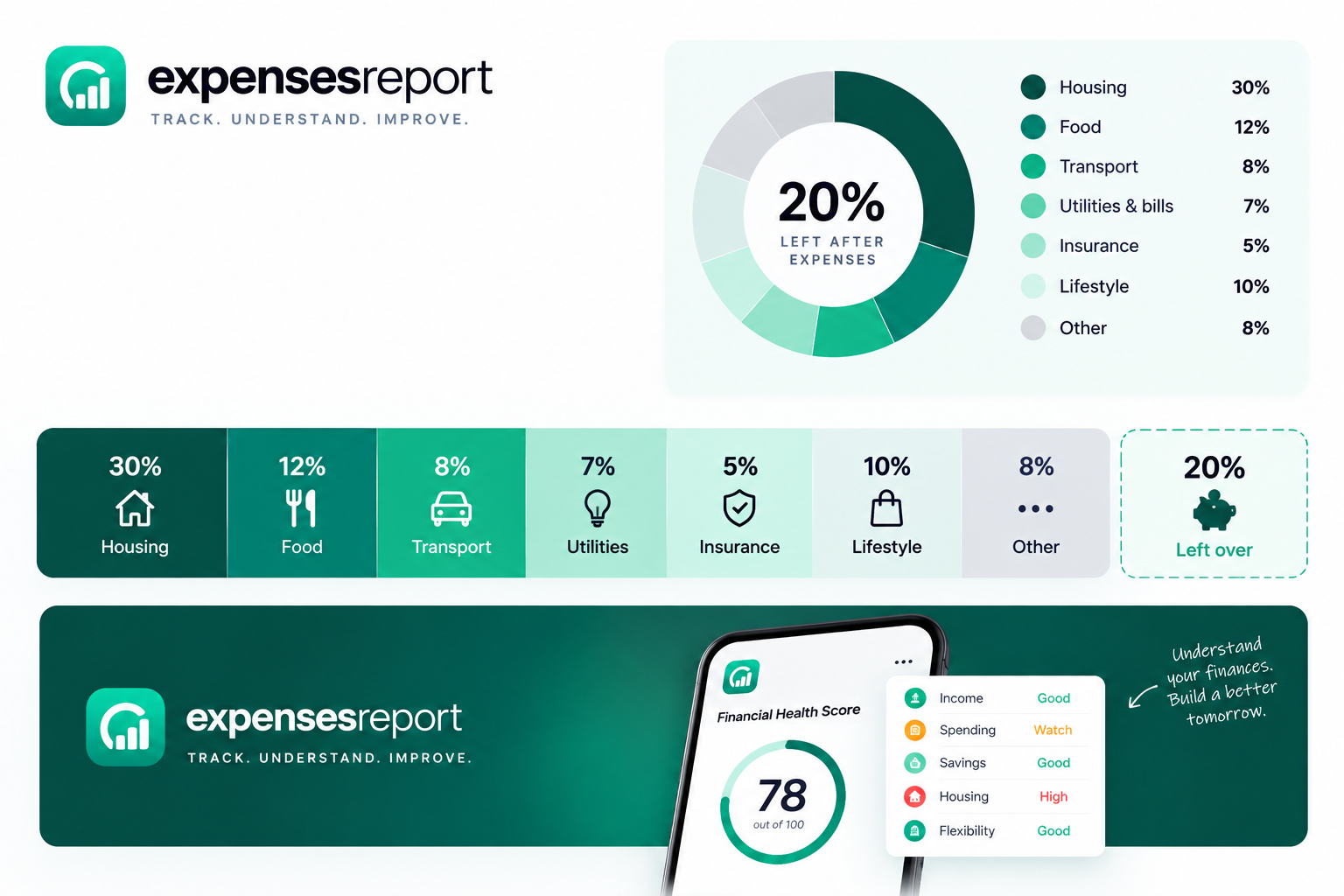
Consider a monthly budget expressed entirely as percentages of take-home income.
| Category | Percentage of income | |
|---|---|---|
| Housing | 30% | |
| Food | 12% | |
| Transport | 8% | |
| Utilities & bills | 7% | |
| Insurance & healthcare | 5% | |
| Lifestyle | 10% | |
| Other expenses | 8% | |
| Total expenses | 80% | |
| Left after expenses | 20% |
In this example, 80% of income is being spent and 20% remains.
That remaining 20% can be saved, invested, used to repay debt faster, reserved for irregular expenses or kept available as a financial buffer.
What is a good percentage to have left after expenses?
There is no universal financial-health threshold. However, percentage ranges can provide a useful starting point for understanding how much financial flexibility your current spending leaves you.
| Income left | What it can indicate |
|---|---|
| Below 5% | Very limited financial flexibility |
| 5–10% | Limited buffer |
| 10–20% | Moderate financial flexibility |
| 20–30% | Strong saving and investing capacity |
| 30%+ | High financial flexibility |
These percentages are guidelines, not rules
Your leftover percentage should never be judged in isolation. Income, housing costs, household size, debt, essential expenses and cost of living can significantly change what represents a healthy result for you.
Is having 10% left good?
Having 10% of your take-home income left after expenses gives you some financial flexibility.
For every 100 units of income you receive, approximately 90 are being spent and 10 remain.
Whether that represents a healthy position depends on what sits behind the number.
Consider:
- Do you consistently retain that 10% every month?
- Do you already have emergency savings?
- Have you accounted for irregular annual expenses?
- Are you carrying expensive debt?
- Is your income stable?
- Is your spending increasing faster than your income?
A 10% leftover rate can be perfectly reasonable in some circumstances. In others, it may leave very little room for unexpected costs.
Is having 20% left good?
Having 20% of your income left after expenses generally provides meaningful room to save, invest or build financial reserves.
Twenty percent is also the savings allocation used in the popular 50/30/20 budgeting framework:
- 50% for needs
- 30% for wants
- 20% for savings and debt repayment
But there is an important distinction.
The 50/30/20 framework is a budgeting method. It does not prove that everyone needs exactly 20% left over to be financially healthy.
Someone living in an area with high housing costs may reasonably spend more than 50% on needs. Someone with relatively low fixed costs may comfortably retain considerably more than 20%.
Treat 20% as a reference point, not a pass-or-fail test
A percentage becomes meaningful only when you consider the financial situation behind it. Your fixed costs, debt, savings, household and goals matter as much as the number itself.
What if you have more than 30% left?
Having 30% or more available after expenses gives you substantial financial flexibility.
It can provide greater capacity to build an emergency fund, invest, save toward major purchases, repay debt faster, prepare for retirement or absorb unexpected expenses.
But having a high leftover rate does not automatically mean your finances are optimized.
If a large percentage simply accumulates in your spending account without a purpose, you may have excellent cash flow but no clear strategy for using it.
Financial health is not about spending as little as possible. It is about allocating your money deliberately.
Why percentages matter more than amounts
Imagine two people finish every month with exactly the same amount of money left.
For the first person, that amount represents 10% of monthly income.
For the second person, it represents 30% of monthly income.
The amount is identical. Their financial positions are not.
Percentages make financial behavior comparable across different salaries and currencies. That makes them particularly useful when trying to understand your spending relative to your earning power.
Ask a better question
Instead of asking “Is having 500 left each month good?”, ask “What percentage of my take-home income is left after expenses?” The percentage gives the amount context and works regardless of your salary or currency.
Leftover rate vs savings rate
This distinction is easy to miss.
Imagine you receive 100% of your monthly income and spend 75%.
You have 25% left after expenses, so your leftover rate is 25%.
But suppose you transfer only 15% into savings and investments while leaving the other 10% available for future spending.
Your leftover rate is 25%, but your savings rate is 15%.
Leftover money only represents the capacity to save. Your savings rate tells you how much you actually put aside.
Housing can completely change the picture
Housing is typically one of the largest household expenses, which means it can dramatically affect how much income remains each month.
Consider two people with identical take-home incomes
| Person A | Person B | |
|---|---|---|
| Housing | 20% | 40% |
| Other expenses | 45% | 45% |
| Left after expenses | 35% | 15% |
Person B is not necessarily worse at managing money.
Their housing situation simply consumes twice as much of their income.
This is another reason why financial health cannot be accurately measured using a single percentage.
Essential expenses matter
Another useful metric is your essential-expense ratio.
This measures how much of your take-home income is committed to costs that are difficult to avoid.
Essential expenses typically include housing, basic food, utilities, insurance, healthcare, necessary transportation, minimum debt payments and essential childcare.
If essential expenses consume 80% of your income, your finances are naturally less flexible than if they consume 45%.
A lower fixed-cost base gives you more room to respond when your circumstances change.
Three financial ratios worth tracking
Expense Ratio
Monthly expenses ÷ net income × 100
Leftover Ratio
Income remaining after expenses ÷ net income × 100
Savings Rate
Amount saved or invested ÷ net income × 100
One number doesn't tell the whole story
Track your expense ratio, leftover ratio and savings rate together. Combined, they provide a much clearer picture of your financial position than your bank balance alone.
Are your finances actually healthy?
Imagine two households both have 20% of their income left every month.
Household A has low fixed expenses, no expensive debt, emergency savings, stable income and controlled discretionary spending.
Household B has high debt repayments, no emergency fund, several large upcoming expenses, unstable income and increasing spending.
On paper, both have the same 20% leftover rate.
In reality, their financial positions are very different.
That's why financial health should be evaluated across several dimensions rather than reduced to one budgeting percentage.
How to increase your leftover percentage
If your leftover percentage is lower than you'd like, start with your largest financial categories.
Cutting several tiny expenses may feel productive, but changing one major recurring cost can have a much larger effect.
- Housing. Check whether housing consumes a disproportionate share of your take-home income.
- Transport. Car payments, fuel, insurance and commuting costs can collectively become one of your largest expense categories.
- Recurring expenses. Review subscriptions, memberships, insurance and services you rarely reconsider.
- Debt. High-interest debt can significantly reduce your monthly financial flexibility.
- Lifestyle spending. Restaurants, shopping, entertainment and travel are generally more adjustable than essential expenses.
- Income. There is a limit to how much spending can be reduced. Increasing income can sometimes improve your financial position more substantially than another round of small cuts.
Focus on percentages that actually move the needle
Start with your largest recurring expenses rather than obsessing over every small purchase. A meaningful reduction in one major category can have a greater impact than dozens of tiny cuts.
Don't optimize around one rule
Personal finance advice often tries to produce one perfect number.
Spend no more than a certain percentage on housing. Save exactly another percentage. Follow 50/30/20.
These frameworks can be useful because they give you reference points. But your finances are a system.
Income, housing, debt, savings, fixed costs, lifestyle, household composition and financial goals all interact.
The objective isn't to achieve a perfect percentage.
The objective is to create enough financial flexibility to cover your life today, absorb unexpected costs and still make progress toward tomorrow.
If you consistently have money left after expenses, you already have one of the most important ingredients.
The next question is whether you're using it effectively.
Frequently asked questions
Is having 10% of your income left after expenses good?
Having 10% left provides some financial flexibility, but whether it is sufficient depends on your essential expenses, debt, emergency savings, income stability and financial goals.
Is having 20% of your income left good?
Having 20% left generally provides meaningful capacity to save, invest or build financial reserves. However, it should be treated as a reference point rather than a universal requirement.
Is having 30% of your income left good?
Having 30% or more left after expenses generally indicates substantial financial flexibility, particularly when you also have manageable debt and adequate emergency savings.
What is the difference between leftover income and savings?
Leftover income is the money remaining after expenses. Savings are the portion of that money you actually put aside. You can therefore have a 25% leftover rate but only a 15% savings rate.
Should savings be counted as an expense?
For financial analysis, it is usually clearer to separate savings and investments from consumption expenses. This allows you to distinguish between money you spend and money you retain for your future.
Sources
- OECD — Household savings — Reference ranges for household saving rates
- Eurostat — Household expenditure statistics — Typical shares of income spent on housing and essentials